The clip above is a short excerpt. Watch the full fireside chat for the whole 30-minute conversation with Jose and Taner.
SMA Awareness Month just wrapped up, and we closed it out with a conversation that was a year in the making.
Since August 2025, close to 300 people in the SMA community have taken part in Unite's SMA Feedback Initiative. Participants sat through interviews, filled out surveys, tested the platform, and told us what worked and what didn't. On Friday, September 4, we brought Jose Flores, SMA advocate, motivational speaker, and bestselling author, and Taner Dagdelen, Unite's co-founder and CEO together for a 30-minute fireside chat. They discussed how the feedback from the SMA community will help transform Unite's platform.
Jose's story
Jose was diagnosed with SMA type 3 at age three, in the 1970s, when there was very little information about the condition and no treatments on the horizon. He had what he calls a great childhood. He walked, ran, rode bikes, and played sports. It was in high school that SMA "really started to show its ugly little head," and at 22 he lost the ability to walk.
What followed was a stretch of anger and questions, and then a 12-year gap in which he stopped seeing a neurologist altogether.
"I hadn't gone to the neurologist in 12 years because I was just upset with getting the same information every time I would go, which was there's nothing down the pipeline, there's no treatments, there's really no hope. And so I just stopped going." — Jose
It was the arrival of treatments that pulled him back in. He got curious and talked to everyone: doctors, neurologists, scientists, researchers. Today he is on the front lines as an advocate.
"I never thought I'd see a treatment in my lifetime." — Jose
One thing Jose was careful to point out is how different SMA looks from one person to the next, even within the same type.
"I'm a type three. I have three copies. And I've met other people with SMA who are also type three with three copies, and we have a completely different story and experience with the condition." — Jose
Being your own advocate
Taner asked Jose about something we heard from many people over the past year: that being your own advocate can be the difference between getting the care you need and getting lost in the system.
"No one's gonna know our needs better than ourselves. We're the ones living through it. We're living with it. And we know what we want and what we need. And we have to be brave enough and courageous enough to communicate those things. Because if not, then we get lost." — Jose
He was candid that this is harder for some personalities than others, and that it requires being willing to be uncomfortable, vulnerable, and persistent.
Taner added a perspective from the other side of the exam room. Physicians care about their patients, but the system gives them 15-minute visits and almost no time to step back and ask how SMA care could be better. Feedback from patients is often the only way that information reaches them.
An uphill battle
Jose described the reality of getting care as an adult with SMA: a system that is not designed for people like him. Being married and working means he and his wife don't qualify for benefits, and he noted that many people in the community avoid marriage for exactly that reason, because they would lose their care.
"That right there, I feel like isn't fair, because that's a matter of literally life and death within our community, or living even just a decent quality of life." — Jose
Even with employer insurance, he has had to fight for things that seem like common sense. When he first lost the ability to walk, he fell and broke every toe on his right foot. He asked his insurer for a scooter.
"They denied me and told me it wasn't medically necessary. I'm like, I don't understand what you guys don't understand. I cannot walk. So how can this device not be medically necessary for me to be able to get around?" — Jose
More recently, switching from the liquid to the tablet form of the same medication took four denials before it was approved. What got him through was a neuro team at the University of Miami that knew how to work the back end, including peer-to-peer calls where his neurologist could explain SMA directly to the insurer's doctors.
"A lot of times the stuff that we need may come across as a want, but it's really not. We actually need these things to be able to just function normally in life." — Jose
The health resume
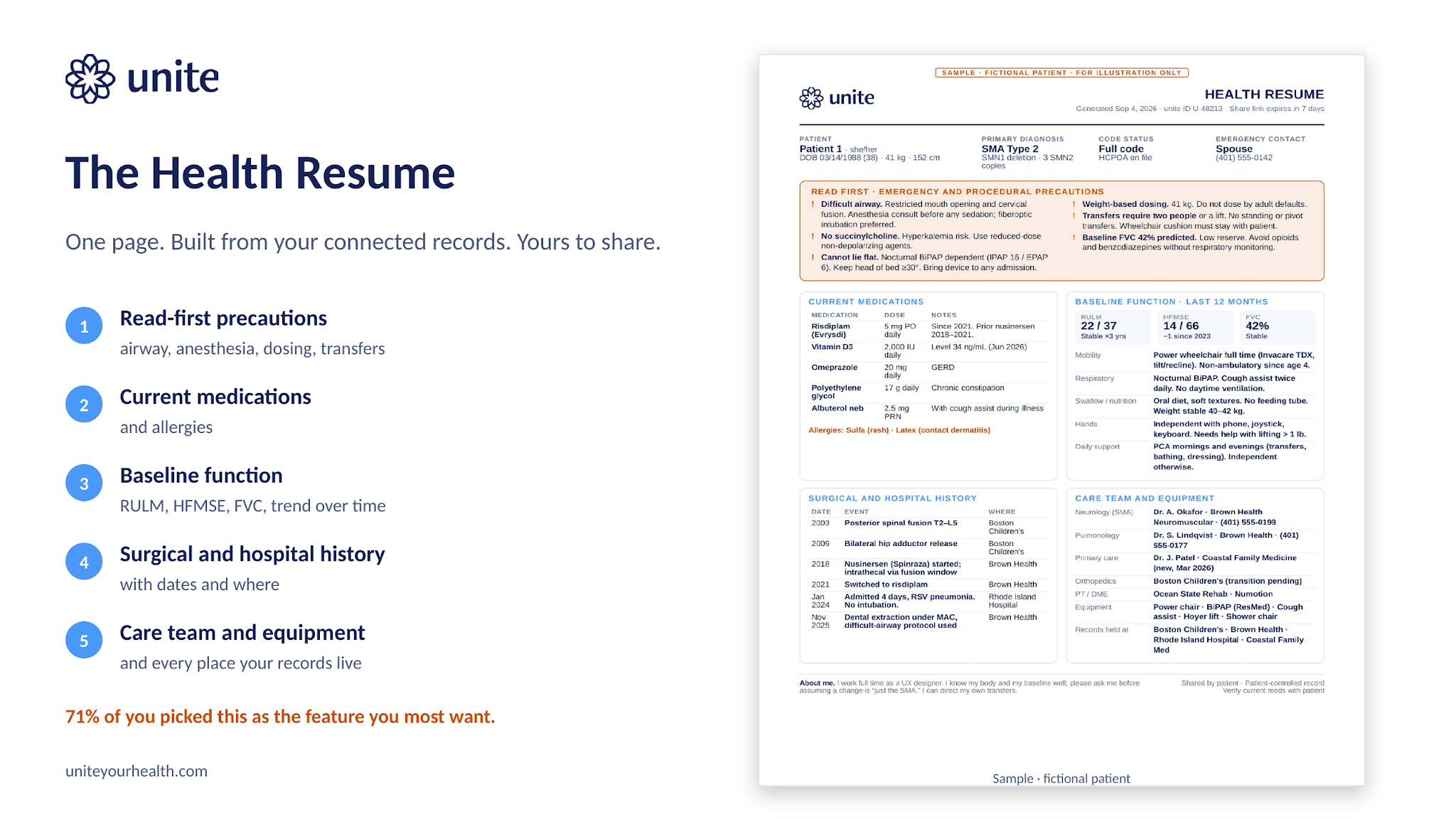
One idea came up over and over in our interviews: a one-page "health resume." Something you could hand to any new doctor so you don't have to retell your whole story from memory, again, to someone who may not know much about SMA.
When we asked participants which feature they wanted most, 71% picked this one.
Taner walked through what we built from that feedback. Once your records are connected in Unite, a button generates a one-page summary that stays current as your records update. New care shows up. Things that are no longer relevant drop off. You don't have to remember what matters or hope the physician asks the right questions.
"I absolutely love this. I have a folder in my phone that has my insurance card front and back, my driver's license front and back, because you go places and they ask for that. This is something like a one sheet that I can download, put in that album, go to my doctor. Here, this is all my information." — Jose
Jose expressed that he "appreciated [that Unite is] not only building the technology, but also including us in the building of the technology, and being open to hearing our voices and listening to what works and what doesn't work, and then building around it."
We enjoyed the feedback on the chat, too! That shows it's resonating and we couldn't be happier. We want to hear what works and what doesn't. We can create the technology, but it has to be useful for the person using it.
"I can sit in my chair here and think up what might be useful, but I'll never be as good as you are at knowing what you need." — Taner
One platform, not ten portals
In his closing thoughts, Jose put his finger on something almost everyone in the initiative described. Three in four participants have SMA records held by two or more health systems, and seven in ten juggle two or more patient-portal logins.
"Every doctor has their own portal now, their own little chart. I go to Cleveland Clinic for my PCP, but I also have my neurologist, they have their chart. My dermatologist, they have their chart. My gastro, they have their chart. My pulmonologist, they have their chart. So you've got to remember all these different passwords and usernames, when you could just go to one platform where all the charts are located, and voila, everything is right there." — Jose
"I'm just grateful that there's even a company out there that's willing to hear our voices and include us, and take our feedback and go build what we need to make our lives easier." — Jose
The SMA Feedback Initiative closes September 30
There is still time to take part, and sharing your story is a paid opportunity.
- ✨ New here? Sign up at uniteyourhealth.com and claim your records.
- 🔗 Already a member? Log in, connect one more system, and update your preferences.
- 🤝 Know someone with SMA? Refer them.
Thank you to Jose, to Taner, and to everyone who joined us on Friday and over the past year. As Taner said, it takes a special person to take time out of their day to think about what might help others in their community. Folks in the SMA community do that all the time.
Want to hear the whole conversation? Watch the full fireside chat here.

Questions? Please reach out to us at jen@unitegenomics.com.