
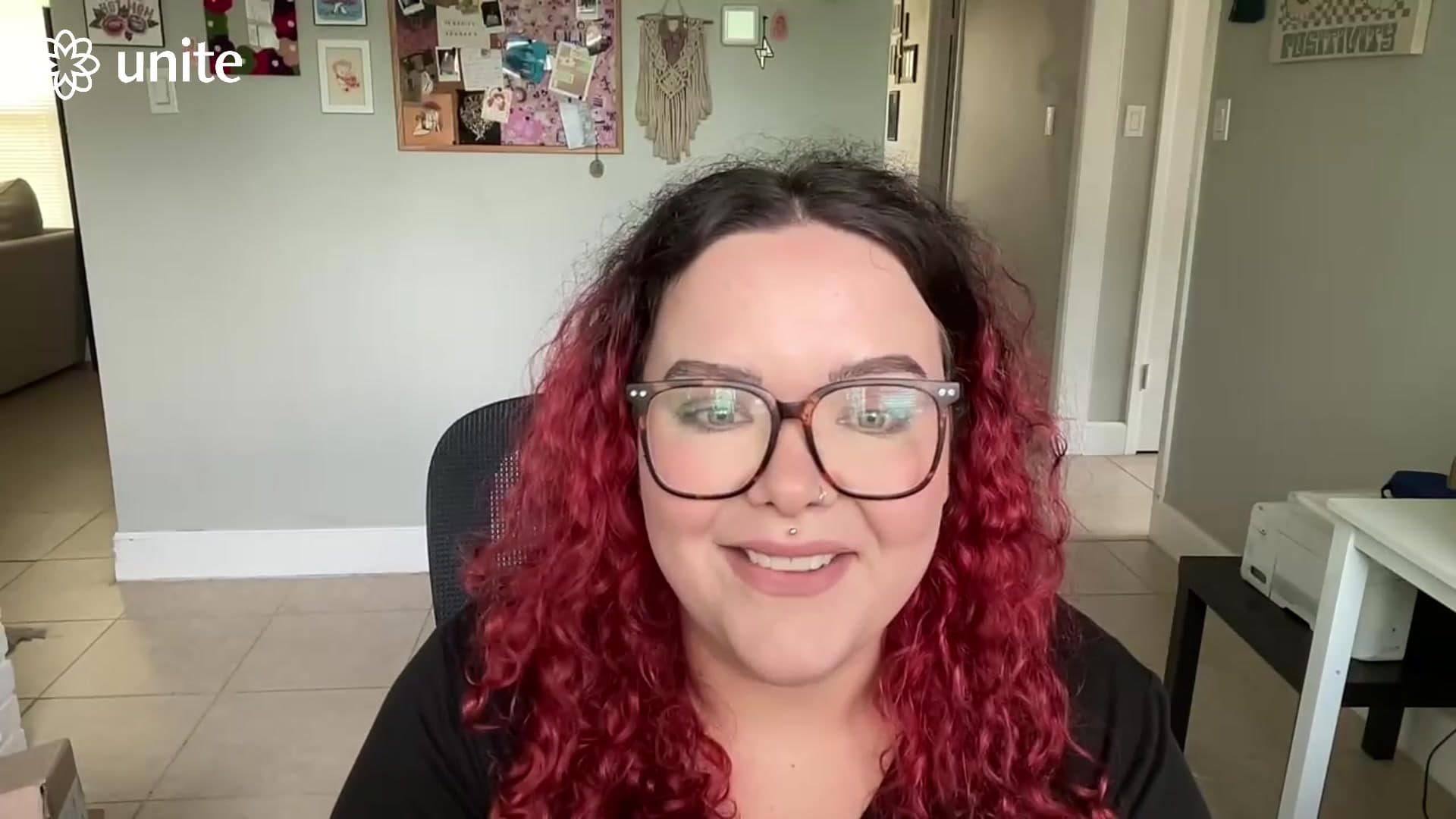
Unite is a platform helping patients take control of their health data. Over the past ten months, we've interviewed over fifty spinal muscular atrophy (SMA) patients, parents, and caregivers and surveyed sixty more. Kenzie is one of those caregivers. This is her story.
What six-year-old boy doesn’t like a good fart joke? Blaise loves hearing them and telling them. He also loves playing with friends, getting muddy, and trying new things. His new favorite? Chips. Last week, he finished his first entire bowl. His mom, Kenzie, called it “Christmas in May.”
Moments like that bowl of chips mean more to Kenzie than most people realize. Blaise has spinal muscular atrophy (SMA), a rare neuromuscular disease that weakens the muscles needed for everyday movements like swallowing, sitting up, and breathing. When he reaches a new milestone, it’s not just progress, it’s proof of his determination and her constant care. Kenzie has become an expert in noticing and celebrating the victories others might miss.
Kenzie welcomed Blaise into the world in January 2020, just as the pandemic fears were ramping up. She left the hospital with a 10-pound baby boy. Within days, her intuition kicked in. Something didn’t seem quite right. The milestones she'd been told to expect weren't coming. Blaise had low muscle tone, trouble breastfeeding, and an aversion to tummy time. The new mom turned into a fierce advocate or, in her words, “the biggest pain in my pediatrician’s side,” showing up weekly insisting, “something’s wrong.” No one was listening.
After weeks of fighting to be heard, Kenzie finally got an answer: Blaise was diagnosed with SMA Type 1 at just 3.5 months old. One week later he received Zolgensma, a newly approved $2.3 million gene therapy and the first ever for SMA. The treatment works by replacing the missing or non-working SMN1 gene with a functional copy. For families like Kenzie’s, it’s nothing short of a miracle drug.
They call the day Blaise received his gene therapy infusion his "second birthday” or even better his “G-birthday.” Before gene therapy, SMA was the leading single-gene genetic cause of infant death. Most children didn't reach their second birthday. Blaise just celebrated his sixth.
“I’m thankful for what his life looks like versus what it would have looked like pre-treatments that weren’t available ten years ago.” — Kenzie
Over the last six years, Kenzie has been both mom and caregiver. “I feel like our day-to-day is pretty normal,” she said, “but then I’ll get around my friends who have completely normal children, and I’m like, wow, I really do a lot.” As a mom, she normalizes Blaise’s day-to-day life. As a caregiver, she operationalizes his care. Kenzie confessed she didn’t “remember much of Blaise’s first few years of life because it was so heavy. There was so much caregiving and treatments and figuring out our norm.”
Learning the difference between caregiver and parent isn’t as straight-forward as it seems. Kenzie admitted, “it was about two years into Blaise’s diagnosis before I realized I wasn’t really parenting. I was just caregiving. I was in survival mode, and I was basically a 24-hour nurse for him.” Kenzie told her therapist, “I have such bad mom guilt because I have to do all these things with my child that he hates. He doesn’t like doing stretches. He doesn’t like getting in his stander. He doesn’t like it when I make him use his manual chair instead of his power chair, just so he can use his arms a little bit. These are things most parents don’t have to do to their kids. And it’s really hard when you’re having to be a nurse and a mom.”
Today, Kenzie and Blaise have their routine mapped out. It’s not the “wake up and brush your teeth” kind of normal. Normal for Kenzie and Blaise is “wake up and do our cough assists and our CPT vests and our suction and our nebs and our stretches, and then we get to our normal parts of the day.” A week could look like six therapy appointments, including physical therapy and occupational therapy. Each session can take two hours at a time. Add in orthopedics, neurologists, and other specialties, and Blaise’s care team totals nine. As Kenzie puts it, they are “frequent flyers at the UT building down in Houston.”
Kenzie said that after a hectic week it’s realizing, "okay, we’ve had a great week, we’ve done all these doctors’ appointments, so this weekend we should go to the movies." She continued, “I’m lucky to have a partner who really pours into that, who treats Blaise like the most typical kid.”
For Kenzie and Blaise today, care is at the high-risk clinic at UT where the team understands the complexities of neuromuscular diseases and knows Blaise. Kenzie said she can “call at three in the morning and a doctor will answer the phone.” As Blaise transitions later in life from pediatric to adult, care management will come with other challenges. “It’s hard to imagine Blaise as an adult just advocating without me,” said Kenzie. “I don’t want him to feel like he’s stuck in Houston the rest of his life. If he wants to go to college in Boston, I want him to be able to go.” That kind of future depends on getting today’s logistics under control.
Managing SMA means juggling specialists, therapies, equipment, insurance approvals, and a constant stream of medical records. For Kenzie, keeping everything organized became a second full‑time job. Fall behind, and you face denials, bills, and, most critically, gaps in the care Blaise needs. In Kenzie's experience, getting access to Blaise's medical records is the primary holdup 90% of the time. Case in point, last summer, she tried to get a hard copy of Blaise’s spinal surgery records. You would think a simple call to the hospital medical records office would result in a simple email reply. Not even close. Tired of waiting after several failed attempts, Kenzie took matters into her own hands. She drove to the hospital, paid for parking, and took the elevator to the basement. After weaving through “dark and dingy” hallways, she reached a one-window counter, made her request, and waited. ”Wow,” she thought, “we’re in 2025 and I am down here in a basement to get medical records.”
The time had come for an easier solution. That's where Unite entered the picture: one place to bring Blaise's records together, track what matters, and prepare for appointments without the usual scramble. Built for SMA families like Kenzie's.
The medical records story in the basement is the easy example, though. The harder one is what keeps Kenzie up at night.
When you travel with a child whose medical care is complex, every trip comes with a deep sense of worry along with a laundry list of questions, prep, and coordination. Kenzie explained, “I find myself obsessing over it, to be honest. Even down to traveling four hours from here to see family in East Texas. I’m looking up every hospital to see which one has the best pediatric wing or where they send their patients if it’s too critical for their hospital.”
Kenzie has rarely traveled with Blaise, and the reason is simple: she's afraid of ending up somewhere that doesn't know him. She's seen that first-hand. Blaise was once rushed to an ER in respiratory distress. When they arrived, twenty people were in the room ready to intubate him. "Hold on, hold on, hold on," she remembers insisting to a wall of clinicians. "Pump the brakes!"
This is the part of caregiving that doesn't show up in a chart. The fear of a provider making a by-the-book decision in an emergency situation about your child because they don't have the last six years of his health history in front of them. And this fear is shared widely in the SMA community. Providers may not have specialized knowledge to safely treat SMA in a crisis situation, and there's no time to re-tell your medical history. A standard medication that's harmless in most patients can trigger a severe reaction in someone with SMA. Unite can be helpful in these situations, housing a one-page health history or a medication list. “If I’m not there to advocate for him or give them the information, it’s so relieving to have that somewhere. It is just like the biggest weight off your chest knowing that it is so easily accessible,” Kenzie emphasized.
Kenzie has operationalized care management over the years. It’s about attention to detail and diligence. Everything is carefully tracked and recorded on a spreadsheet that she updates every six months with in-case-of-emergencies info. “God forbid something happens to me. I need a friend to always know where to go to find his doctor’s names, his medications, his allergies, his past surgeries,” explained Kenzie.
This is another care gap Unite was built to solve. It’s not a warehouse of records, but a compendium of care in one place. For Kenzie, whether it's Memorial Hermann, Scottish Rite, or an ER in a city they’ve never been to, the same picture of Blaise shows up first: his history, his medications, his abilities, what to do and what not to do.
“I do love what Unite has done where I can log on to a portal and say, "hey, here’s all his medical records right here" instead of having to wait or hope that they get them all.” — Kenzie
Care management, access to medical history, and insights are only the starting line. Caregivers need a resource to give them back time - time that can be spent being with their loved one, and not chasing records or having to retell a complex medical history.
At the end of our conversation, Kenzie said something that will be encoded in Unite’s DNA as the platform matures: "Disabled family members are forgotten about often. But caregivers are forgotten about even more." That's the gap. Records, reminders, history, community. None of it is the point on its own. It’s about giving caregivers like Kenzie back a little of what they've been pouring out for years: time, peace of mind, and the confidence that whether Blaise is at Memorial Hermann, at Scottish Rite, or one day arriving at a clinic in Boston, his story travels with him. Unite is for both of them.
If you're a patient or caring for a loved one with SMA, you can create an account on the Unite platform to access medical records from providers and help manage care. We also have an ongoing SMA Feedback program. If you join, your voice will be part of shaping the platform, so we can get the experience right for SMA patients and caregivers.